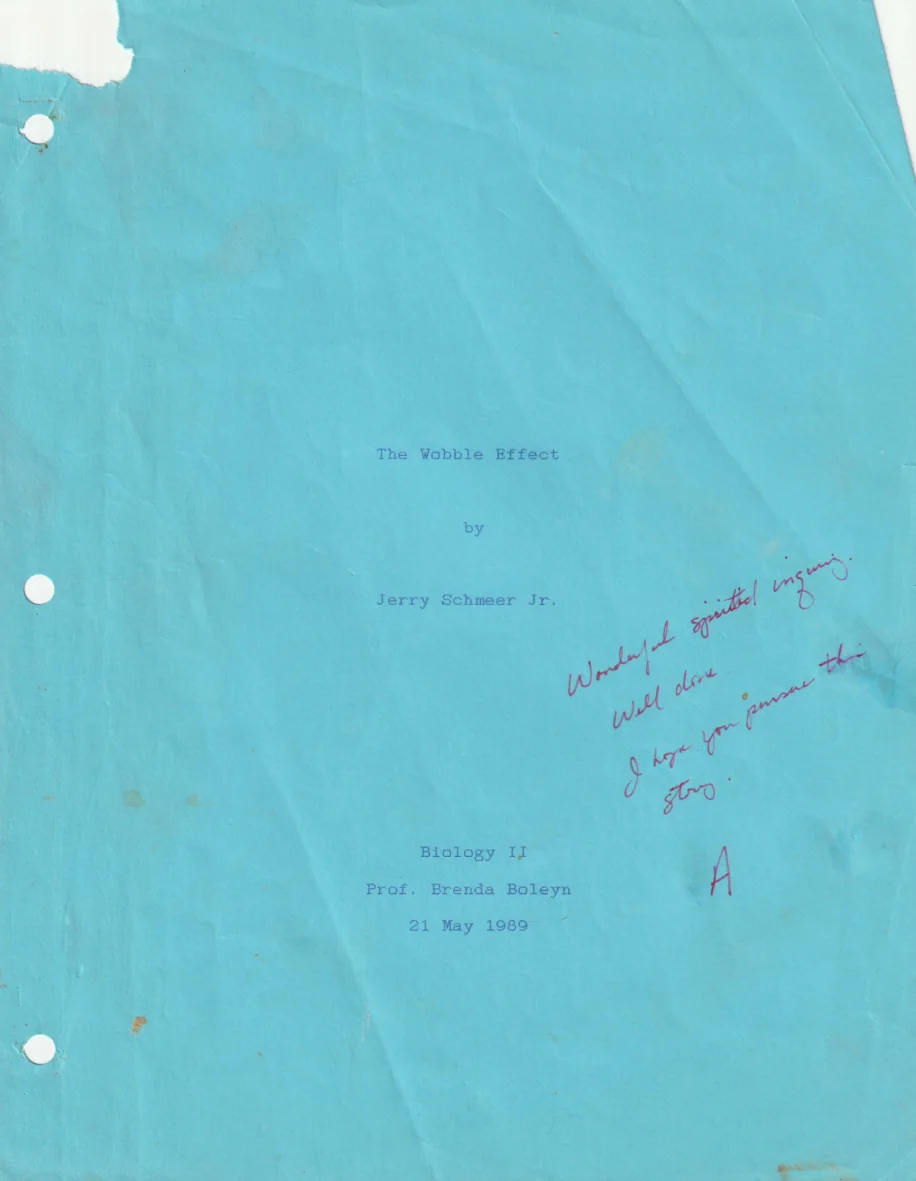
“One of the great things about never growing up is, like a child, your mind still works in questions. It seems I never run out of them.”
The Question Behind the Paper
In 1989, while taking Biology II at Cape Cod Community College, I became fascinated by one question in particular: where is the biological clock? What is it that allows living cells and organisms to carry on an orderly sequence of events through a lifetime—and what gives that clock its frame of reference?
My mind had already spent plenty of time wandering through questions about gravity, the limits of the universe, the pyramids, and aging. For this paper I tried, with mixed success, to keep myself centered on just one of them: why do living things grow old and die?
I was not trying to write about aging simply as the gradual breakdown of biological systems. I was looking for something deeper: an internal timing mechanism that might underlie important biological processes throughout the life of an organism.
A Clock That Would Have to Be Universal
The idea that guided me was simple. If the same basic elements exist throughout the universe, then any truly fundamental biological timing mechanism should not depend entirely on local events such as sunrise, sunset, or the particular day-and-night cycle of Earth. Those environmental rhythms could influence life, certainly, but I wondered whether there might be an underlying clock operating on an atomic or molecular scale.
That led me to a definition of timekeeping I could work with: clocks count a regular series of events. A pendulum swings. A balance wheel oscillates. A quartz crystal vibrates. If a biological clock existed, perhaps it too was counting something regular.
Learning From a Computer Clock
Because computers were already familiar territory to me, I used a simple computer clock as an analogy. A computer needs a timing source, a place where the pulses are counted and interpreted, and a broader system that uses the resulting timing information. The quartz crystal provides a steady oscillation; the processing circuitry counts it; memory and the rest of the computer act on the timing.
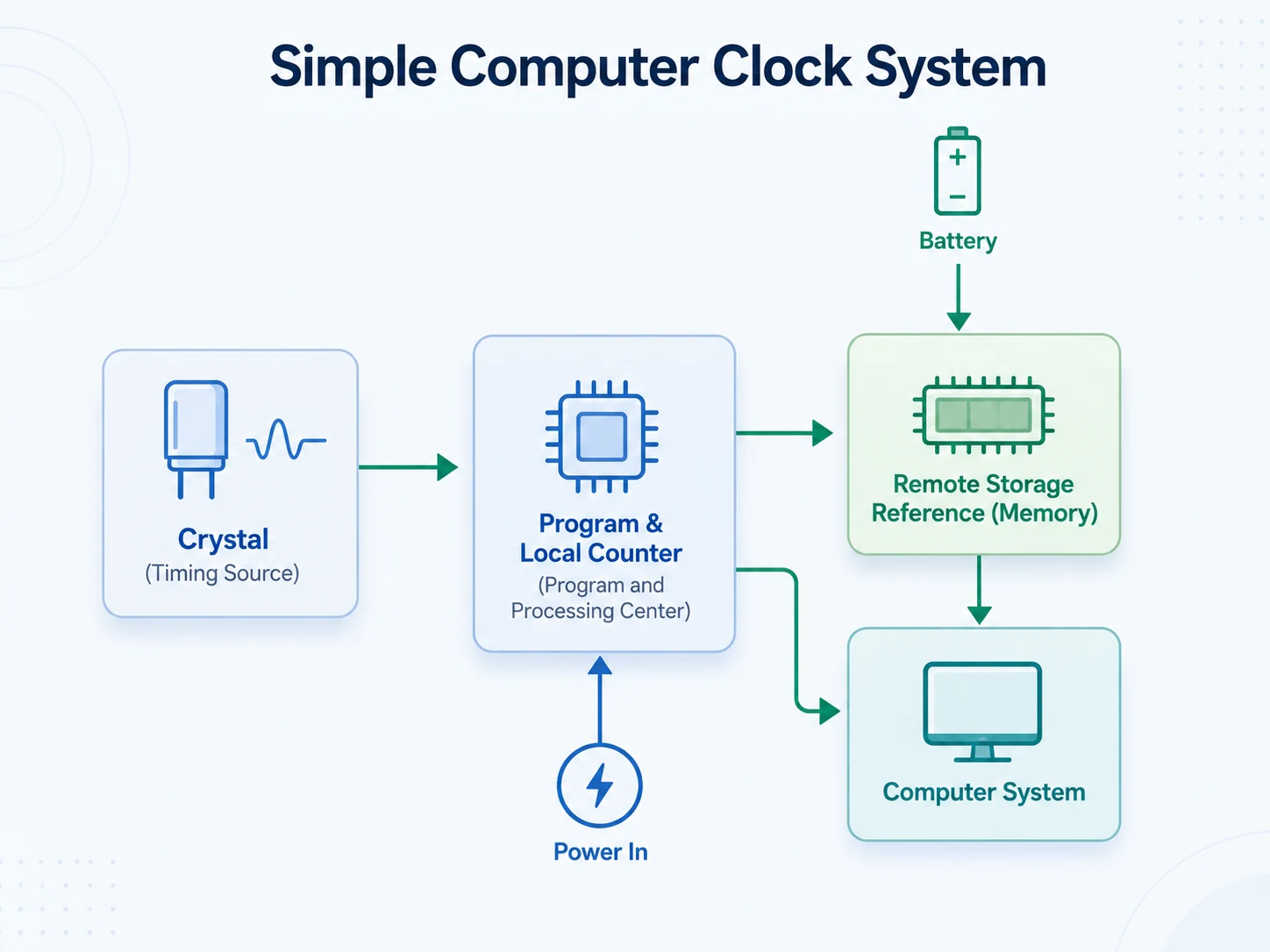
My hope was that by studying a simple machine I understood, I might recognize a similar pattern in a much more complex biological system.
Why Water Kept Appearing
I started looking at things that seemed, in one way or another, to resist the normal march of biological aging. Seeds can remain dormant for long periods and then begin growing when conditions are right. Freeze-dried food can sit inactive until water is added. Biological material can be preserved by cooling or freezing. In my student investigation, water seemed to keep turning up in the story.
Water had always fascinated me: its connection to life, its unusual properties, and its molecular structure. So I made it the center of the hypothesis.
Three things I wanted to find
The Wobble
The first part of the search delighted me. In chemistry texts I found that molecules do not sit perfectly still. Their atoms vibrate around mean positions, and those vibrations can be described in fundamental modes. For water, the motions include symmetrical stretching, asymmetrical stretching, and bending.
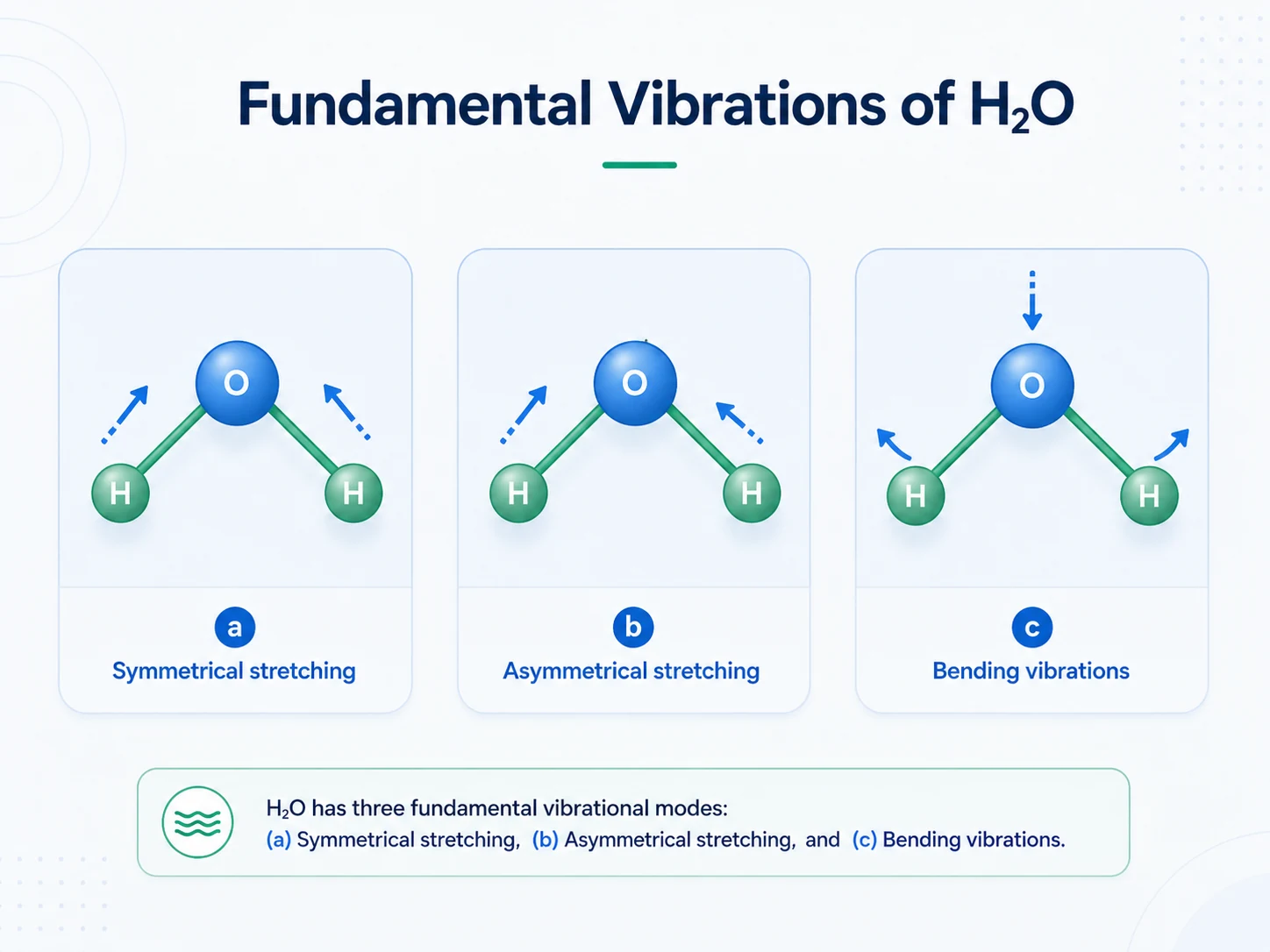
That was the moment the name The Wobble Effect really made sense to me. Water moved. It oscillated. In principle, oscillations can be counted. That did not prove my idea, but it gave me the regular physical event I had been looking for.
Rhythms That Keep Going
Next I looked at circadian biology. What caught my attention was the idea that biological oscillators can remain synchronized even when an organism is not being driven continuously by an outside periodic environment. To me, that suggested an internal mechanism capable of maintaining rhythm rather than merely reacting to sunrise and sunset.
I also encountered research in which changing the composition of water affected biological rhythms. At the time, I took this as another clue that molecular properties of water might somehow participate in timing. The leap from that observation to my proposed mechanism was mine—and it was a large, speculative one—but it pushed the investigation forward.
Water Meets DNA
The hardest part was finding a reason to connect the timing source I imagined with DNA, where I believed the biological “program” might reside. While searching scientific journals at Woods Hole, I found research describing water molecules associated with DNA and participating in the stabilization of its structure.
That was the connection I had been searching for. Water was not merely somewhere else in the cell; it could be physically associated with DNA. From there I imagined a much more speculative possibility: perhaps some portion of the DNA system could act like a discriminator in a radio or a clock circuit—responding to a particular molecular oscillation and, in effect, counting it.
A Human Clock Model
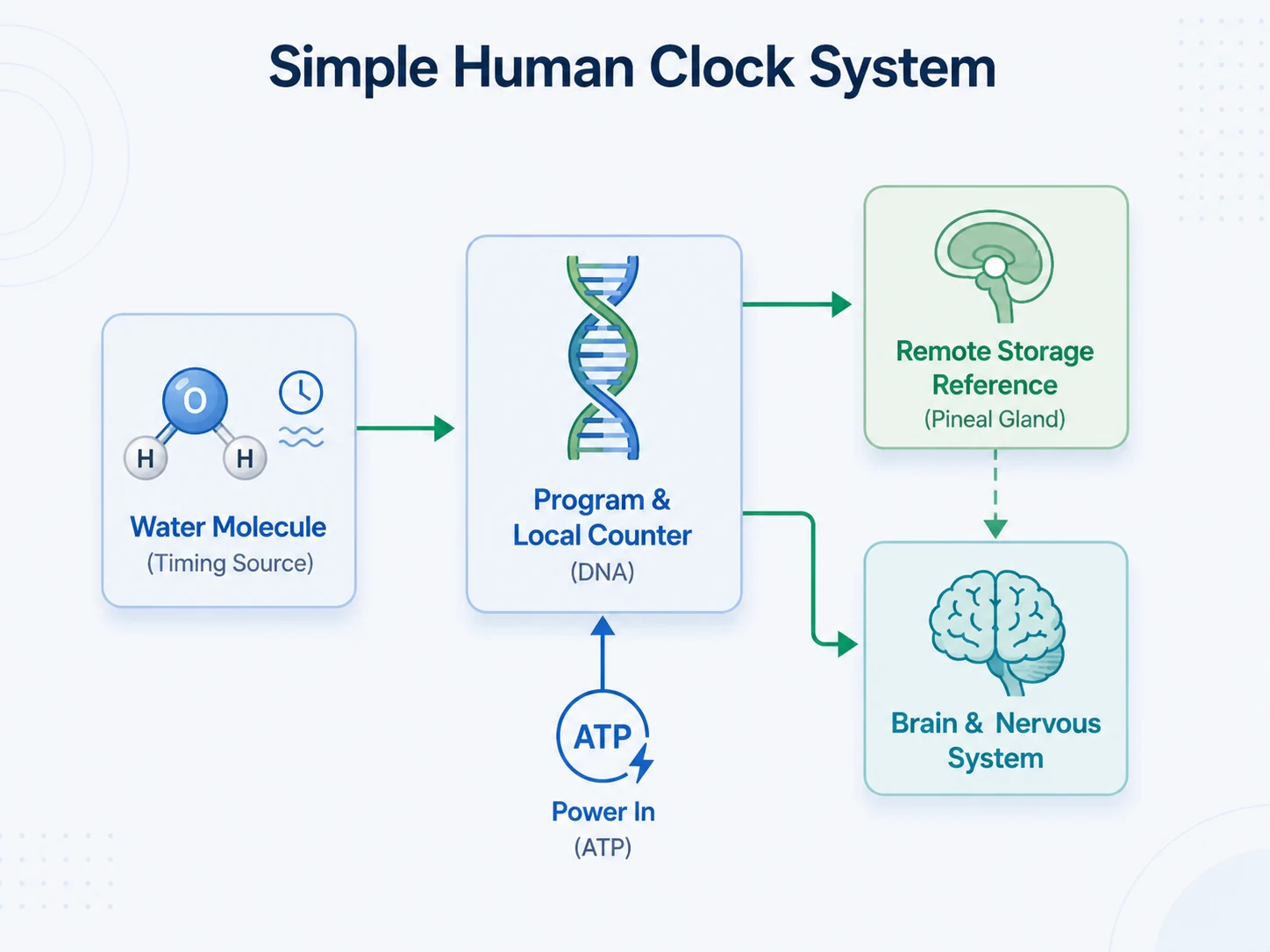
Once I had those pieces, I drew a biological version of the computer clock. In my model, the vibrating water molecule became the timing source. DNA became the program and local counter. ATP supplied energy. A brain-based reference system provided a larger coordination point, and the nervous system became part of the system that acted on the timing information.
Where I Landed in 1989
The paper ended with a burst of confidence that makes me smile today. I wrote that I believed water was the answer and wondered whether, if such a system existed, the oscillation might someday be influenced externally. I was excited by the possibility and wrote that I planned to pursue it in the “many, many years to come.”
What matters most to me now is not whether the hypothesis survived four decades of biology. What I recognize in these pages is something that has stayed with me: the instinct to look for patterns between fields, to take something I understand in one world and use it as a lens on another, and to keep asking questions long after a sensible person might have stopped.
The historical source
Read the Original 1989 Paper
I have preserved the original scanned pages—including my drawings, the instructor's markings, and the paper as it existed in 1989. The modern illustrations above are visual recreations; the PDF below is the historical source and has not been rewritten or modernized.
Open the Complete Original PDF